


Designer | Maker
I've always thought of myself as both of those words at once, not one or the other. A lot of design happens at a desk, or in a sketchbook, or in a moment of clarity that has nothing to do with tools. But the work doesn't become real until it's made — until a material has been cut, shaped, joined, finished. I want to write a little about both halves of that: where the ideas come from, and what I'm turning them toward next.
Where the Ideas Come From
I follow different disciplines for inspiration less for their techniques than for their storytelling — the way art, fashion, and architecture each construct a narrative through form, and what that narrative reveals when it's stripped back to its essentials. Moving between fields keeps me from settling into any one discipline's assumptions. An idea can come from an afternoon spent somewhere entirely unrelated to furniture or bathrooms — that's exactly what happened with Arc, which began on a stroll through an Italian arcade, or Facet, which grew out of the aesthetics of low-polygon computer game graphics. Neither started as a design problem. Both became one.
Symmetry, Proportion and Story
For me, product design comes down to a balance of three things: symmetry, proportion, and reduction. None of it starts as calculation. It stems from our own experiences — the spaces we've stood in, the objects we've used without thinking, the details that stayed with us for reasons we couldn't always explain at the time. Arc and Facet both prove that out: an arcade and a video game aren't design references in the traditional sense, they're experiences, and the design work is really the process of translating an experience into proportion and form.
Sometimes the best designs tell a story. Sometimes they just fulfil a function, cleanly and without ceremony, and that's enough. I don't think one is more honest than the other — a story and a function are both ways of a design earning its place. What I do believe is that experiential design, design shaped by real, lived experience rather than trend or habit, makes the world a little better for us and for whoever inherits what we make next.
Reduction
Design, at its best, is a bit of a conundrum — a constant cycle of decisions, each one stripping something back. I hold my own work to that standard: an object shouldn't announce the hours spent arriving at its curve or its surface. If the design has done its job, none of that struggle is visible — just the object, resolved, doing what it needs to do and nothing more.
Custom Furniture
That same thinking carries into our custom furniture and cabinetry work — made to order rather than to a fixed catalogue, and built around a specific space, a specific brief, a specific person's rooms, rather than a general collection. It's a natural extension of the way I already work: the same discipline of reduction, the same attention to material, just applied to one room and one client at a time.
The Bora credenza, pictured here with three drawers in a warm yellow, is one of the latest pieces to come out of that process. It carries the same wood-and-aluminium language as the rest of the Bora collection, but finished as a standalone piece of furniture — something to be lived with in a room, not just installed in a bathroom. The colour was a deliberate choice: warm, confident, not trying to disappear into a room the way I usually ask my materials to. Sometimes restraint means knowing when not to reduce.
Custom work changes the process a little. It starts the same way everything does — with a conversation, a sketch, a material — but it ends somewhere more specific, shaped by a room I've actually seen and a person I've actually spoken to. It's one of my favourite parts of what we do.
- Mark Jankowski, Founder.
Read more
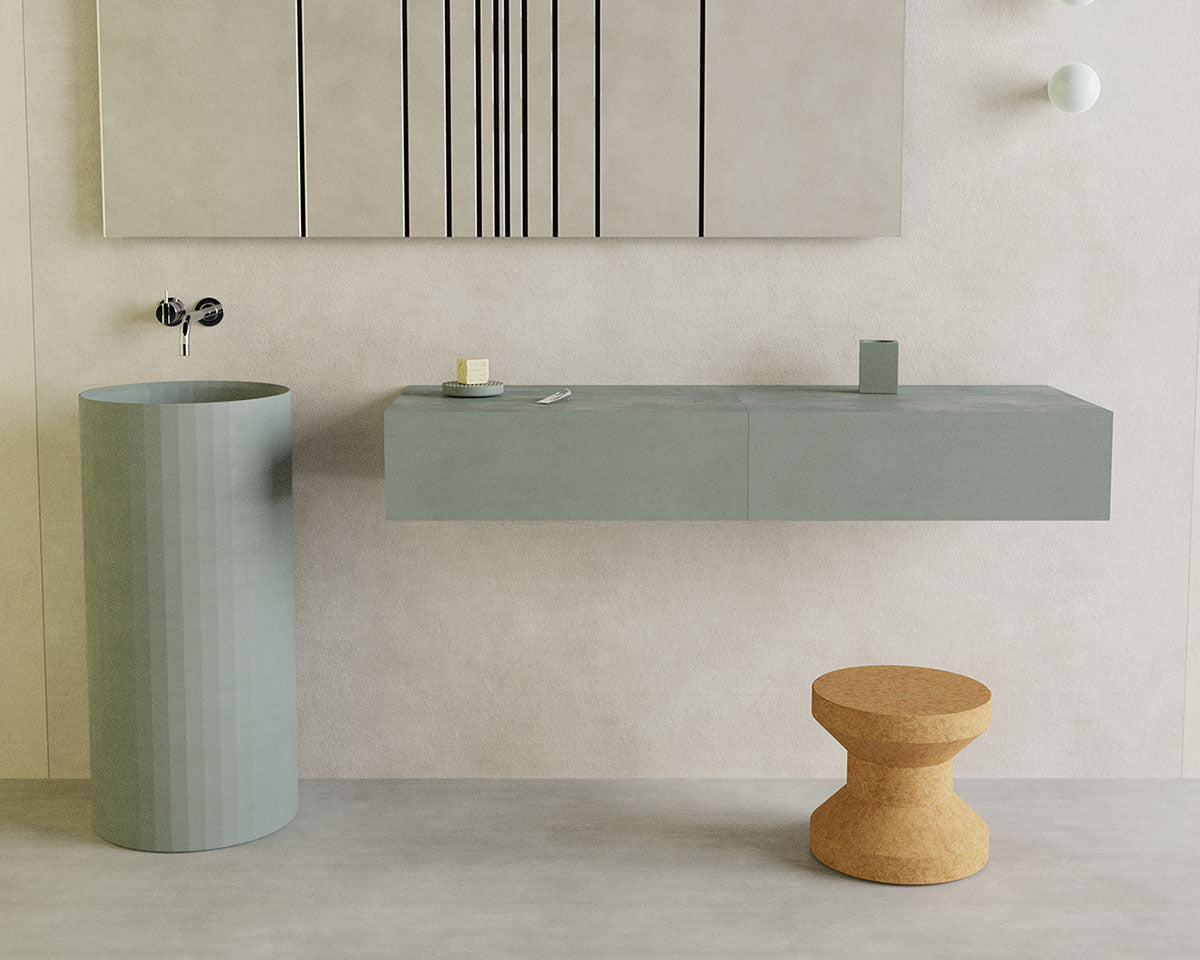
Designing toward invisibility Most people imagine creativity as a flash of inspiration — an image that arrives whole and only needs to be executed. In truth, the majority of my design process looks...
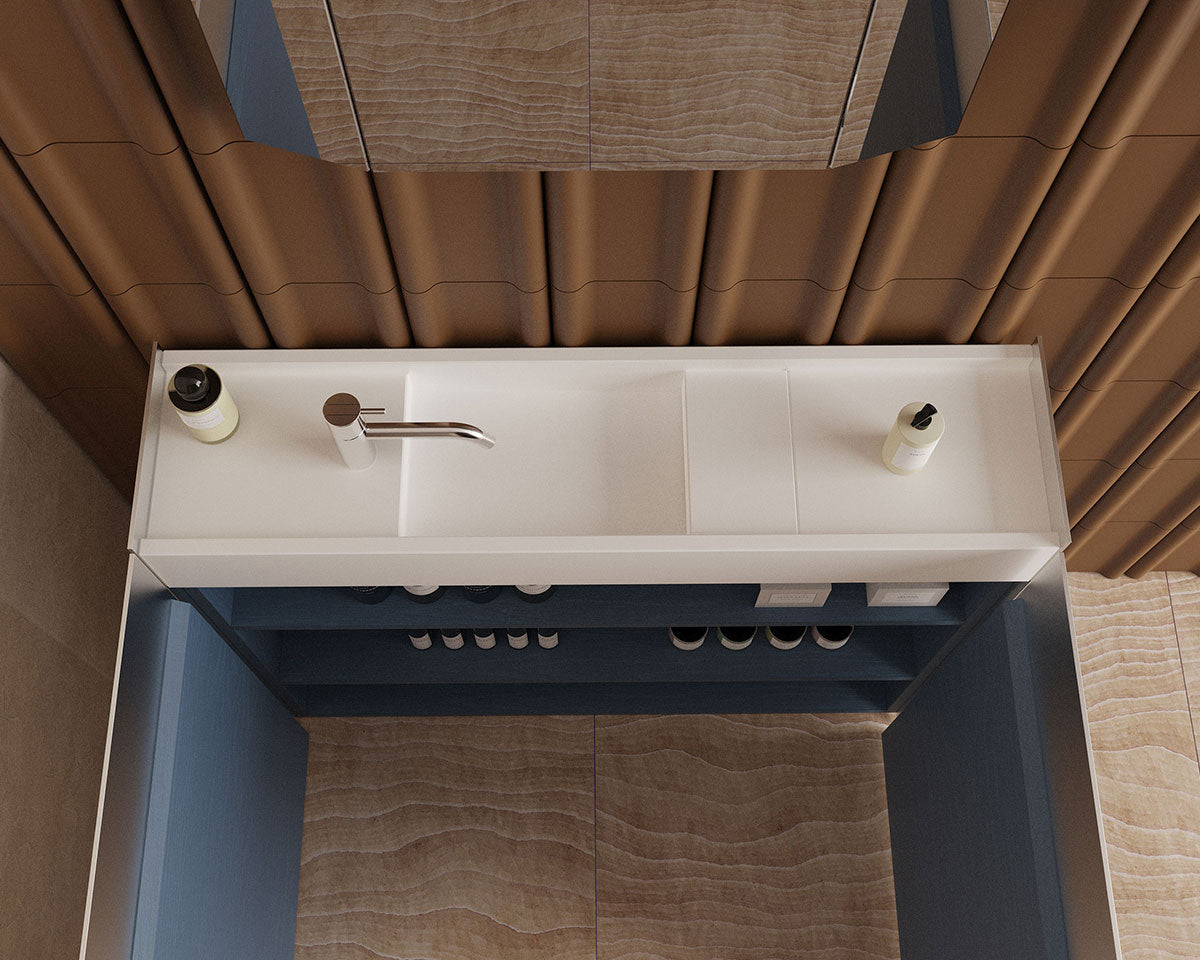
Real Materials, Built to Last Generations Most bathroom cabinets are built around finishes that fail. Laminates and synthetic veneers look consistent for a while, but once moisture gets under t...